
Workshop Notes
When Sacred Writing Becomes Image
Reflections on the second Shaping Holiness workshop

What might an Egyptian tomb, a medieval Gospel book, a synagogue wall, a Vietnamese religious print, and Chinese-Arabic calligraphy have to say to one another?
Quite a lot, as it turned out.
From 10 to 14 August, the second Shaping Holiness workshop brought scholars from different fields and religious traditions to Freie Universität Berlin to explore a deceptively simple question: What happens when sacred writing becomes visible? Sacred texts, after all, are not only read and recited. They enter visual culture in remarkably different ways: as depicted books and inscriptions, as calligraphy and ornament, as elements of narrative images and ritual spaces, and sometimes as images in their own right. The relationship between writing, image, object, and religious presence stood at the centre of our discussions.
The range of material could hardly have been broader. We moved from writing hands and open books in medieval Christian art to Gospel books used in oath-taking; from Torah shrines and synagogue murals to illustrated Bhagavata Purana manuscripts and mural painting in Kerala; from ancient Egyptian tombs to Ottoman visual theology, Jewish ritual spaces, Vietnamese religious prints, and the visual world of the Han Kitab tradition.


Yet the breadth of the programme did not result in a collection of unrelated case studies. Quite the opposite. Again and again, similar questions surfaced in very different contexts. When does writing function as text, and when does it become image? How can a sacred book itself become an image? How do script, calligraphy, and inscriptions become visual media of religious meaning? And how can images interpret or even reshape the authority of sacred texts? What difference do colour, scale, material, and spatial setting make to the way writing is perceived?
Some of the most interesting moments came when categories we had taken for granted began to become less clear-cut. The distinction between text and image, for example, proved much less obvious once Egyptian inscriptions, pictorial rubrics in medieval sacramentaries, Islamic calligraphy, Jewish ceremonial objects, and Vietnamese visual scriptures were considered alongside one another. A written sign can communicate linguistically and visually at the same time; an image can quote, embody, or interpret a text. Sacred writing repeatedly appeared not simply as a carrier of meaning but as an element within religious space and practice.
This was also what made the discussions so productive. A question arising from a medieval Christian object could unexpectedly become relevant to Jewish or Islamic material; a problem of embodiment in South Asian art could cast a different light on the representation of scripture elsewhere. The point was not to erase the differences between these traditions, but to see what new questions emerge when they are considered alongside one another. The papers themselves approached this relationship through manuscripts, paintings, murals, ritual objects, inscriptions, and sacred spaces.
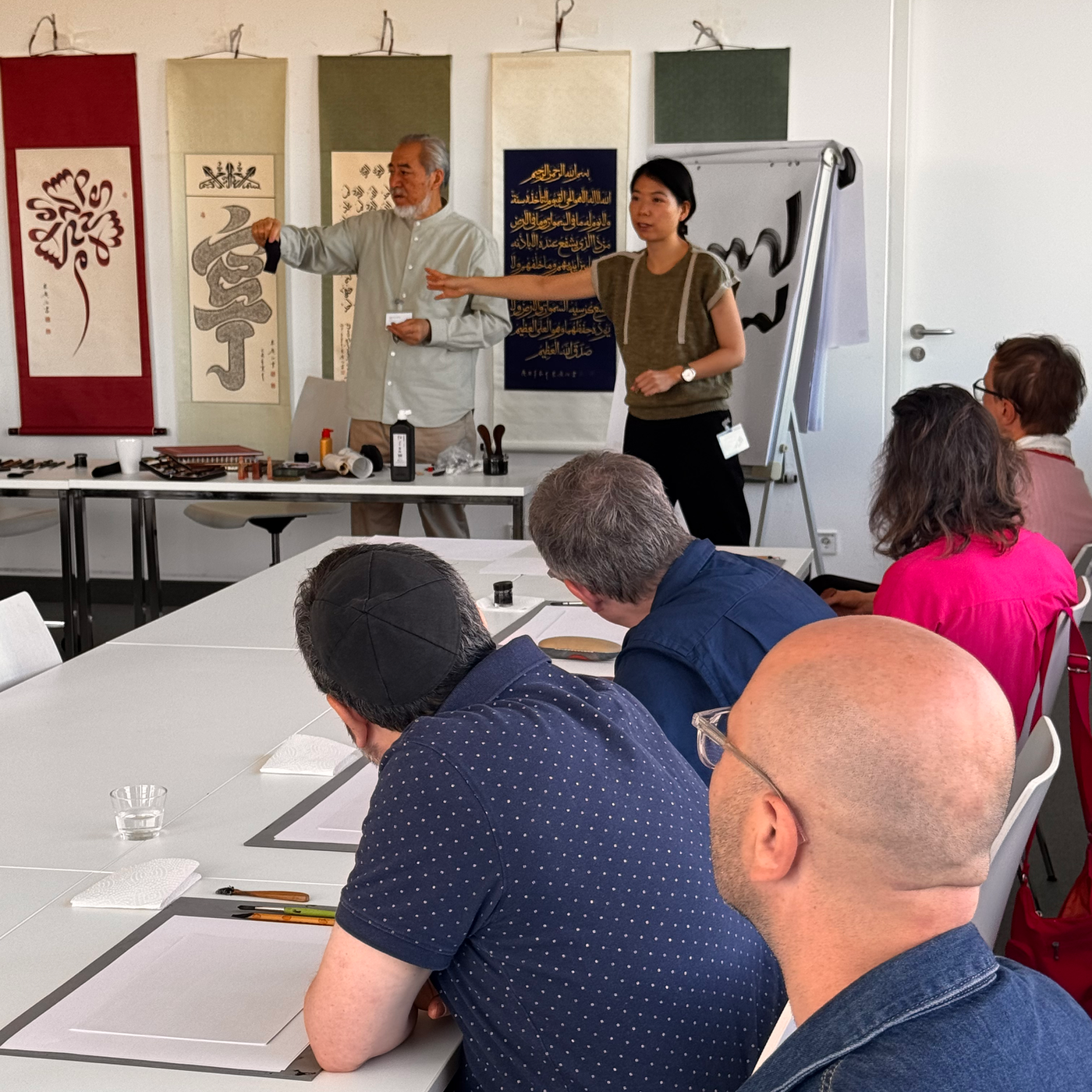
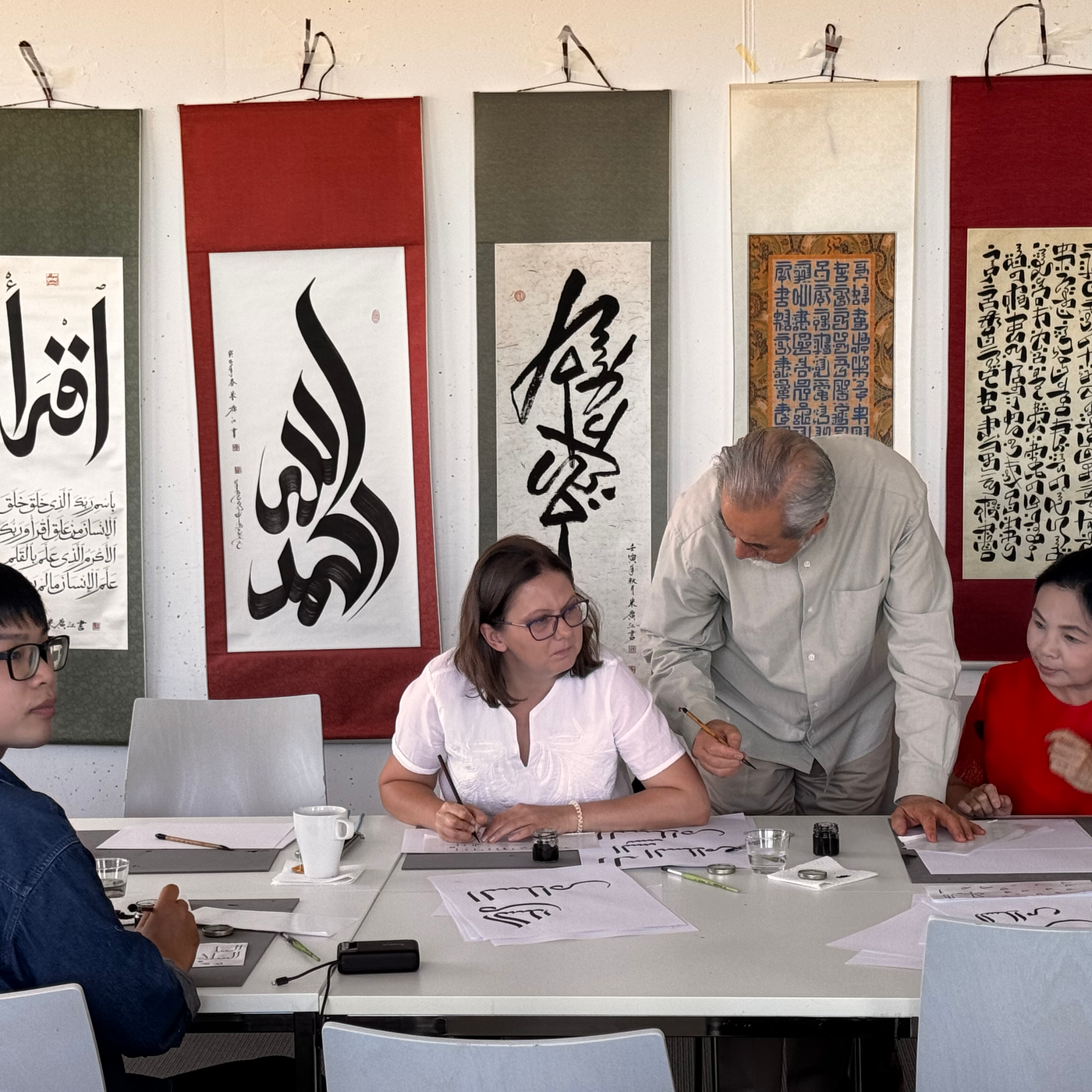
On Wednesday morning, the perspective shifted—from looking at calligraphy to making it ourselves. Haji Noor Deen introduced us to Sini calligraphy and showed us how Chinese Muslim calligraphers brought Arabic script into dialogue with the expressive possibilities of the Chinese brush. After two days spent analysing the visual power of writing, we now took up brush and ink ourselves. It was great fun, but also made very tangible how much control, movement, and concentration lie behind a single line.




Later that afternoon, our visit to the Conservation and Restoration Department of the Staatsbibliothek zu Berlin brought us from representations of sacred books back to the physical objects themselves. The conservators allowed us to look closely at manuscripts and rare books and introduced us to some of the practical questions involved in their examination and preservation. The workshop concluded on Wednesday evening with a concert by pianist Tomas Bächli, who performed works by the Swiss composer Martin Wehrli alongside selections from Johann Sebastian Bach’s French Suites. After three intensive days of papers, discussions, calligraphy, and manuscripts, it was a welcome change of pace and a lovely way to end our time together.
We left the workshop with many new questions about the relationship between writing and image—and with plenty of material for further conversations.